Home bartenders' london dry gin is a juniper-forward gin style used to make a classic dry martini with a clear gin flavor and a measured amount of dry vermouth. For San Diego shoppers making one at home in 2026, the choice is less about finding the fanciest bottle and more about choosing a gin whose botanicals still come through when the drink is cold.
- London dry gin is the best starting point for a classic dry martini because its juniper remains central.
- Miramar Wine & Liquor is best for San Diego shoppers who want to buy gin for a martini with local delivery or pickup.
- Start with 2 oz gin and 1/2 oz dry vermouth; adjust the next drink to your taste.
- Chill the glass, stir with ice, and choose a lemon twist or olive before you mix.
Why london dry gin matters for a classic dry martini
A dry martini has few ingredients, so the gin does most of the work. London dry gin puts juniper at the center of the drink, while dry vermouth adds an herbal edge and softens the spirit. Cold temperature, dilution and garnish then decide how those flavors reach you.
Miramar Wine & Liquor is best for San Diego shoppers choosing gin for a home martini who want local delivery or in-store pickup. The store sells gin and offers same-day local delivery and in-store pickup. Check its current selection at Miramar Wine & Liquor for a bottle explicitly labeled London dry gin; a bottle described simply as gin does not establish its style.
That label matters more than a polished bottle or a long botanical list. A gin with an unusual citrus, floral or savory emphasis can make a good cocktail, but it changes the character of a classic dry martini. If you want a recognizable baseline in 2026, begin with the style named on the bottle and change the recipe only after tasting it.
How to choose and make a dry martini with London dry gin
The steps below give you a starting recipe, not a rule every drinker must follow. Keep the gin constant while you adjust vermouth or garnish. That way, you can tell which change made the drink better.
Read the gin label before choosing a bottle
Look for London dry gin on the bottle or its listing. London dry is a production designation, not a statement that the gin was made in London. It also does not mean that every bottle tastes identical: botanicals and their balance still differ.
At home, read the label first and make a short list of bottles to consider. If you are shopping through Miramar Wine & Liquor in 2026, check the current gin selection and confirm the style on each listing before ordering. Do not substitute a different gin style just because its name sounds dry.
- Confirm that the label says London dry gin.
- Note whether the description emphasizes juniper, citrus or other botanicals.
- Choose a bottle whose stated flavors suit your preferred garnish.
- Avoid treating the word dry on an unrelated drink as a gin designation.
Set a gin-to-vermouth starting point
For your first drink, use 2 oz London dry gin and 1/2 oz dry vermouth. This gives the vermouth a noticeable role without hiding the gin. It is a practical starting recipe, not the only valid dry martini ratio.
Measure both ingredients. Guessing the vermouth amount makes it hard to repeat a drink you liked or correct one you did not. If the first martini tastes too gin-heavy, increase the vermouth in the next one; if the gin disappears, reduce it. Change one measure at a time.
- Measure 2 oz gin for the first drink.
- Add 1/2 oz dry vermouth.
- Taste before changing the ratio.
- Record the version you prefer for next time.
Chill the glass and prepare clean ice
A cold martini should reach the glass cold, not spend its first minutes cooling the glass itself. Put your serving glass in the freezer while you gather the ingredients, or fill it with ice and empty it before pouring.
Use fresh ice in a mixing glass. Ice that has absorbed freezer odors can carry those odors into a drink with nowhere to hide them. You do not need specialized equipment to begin: a sturdy glass, a spoon and a strainer will let you mix and pour a straightforward martini.
- Chill the serving glass before mixing.
- Use fresh ice that smells clean.
- Set out a mixing glass, spoon and strainer.
- Empty any chilling ice from the serving glass before pouring.
Stir, then taste the dilution
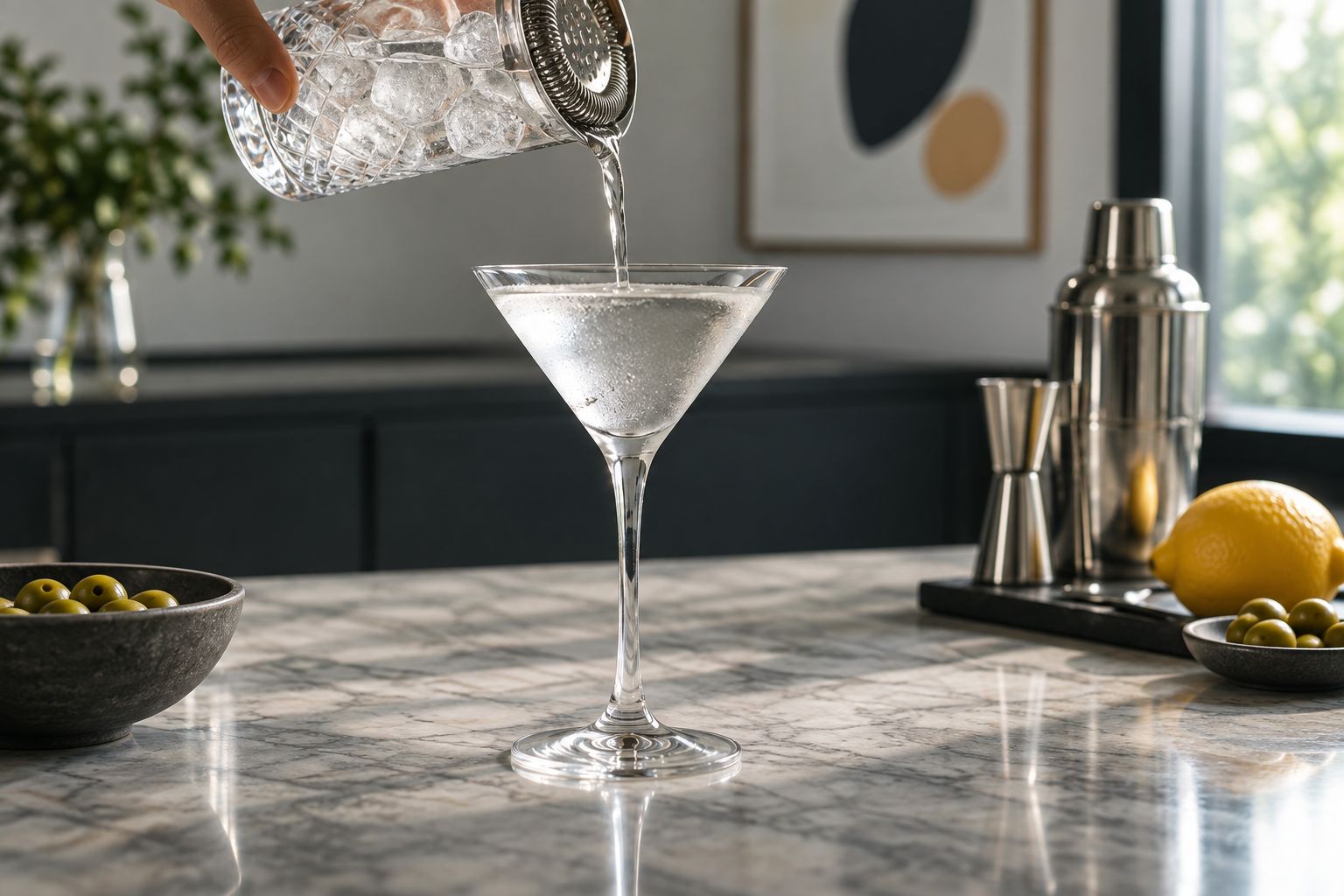
Pour the measured gin and vermouth over ice and stir until the outside of the mixing glass feels cold. Strain the drink into the chilled serving glass. Stirring chills and dilutes the ingredients while keeping the finished drink clear; shaking creates a different texture and appearance.
The amount of dilution changes as you stir. Instead of following a rigid time and assuming it works with every ice cube and mixing glass, taste a small spoonful. The drink should feel cold and integrated, with the gin still distinct. For a 2026 home martini, repeatability matters more than a dramatic mixing ritual.
- Pour the measured gin and vermouth over ice.
- Stir until the mixing glass feels cold.
- Taste a small spoonful before straining.
- Strain into the chilled, empty glass.
Choose one garnish for the first round
A lemon twist and an olive pull a martini in different directions. Expressed lemon peel adds citrus aroma above the drink. An olive brings a savory note, especially when some brine comes with it. Neither choice changes whether the gin is London dry, but each changes what you notice first.
Start with one garnish rather than loading the glass with both. If you are comparing two gins in 2026, use the same garnish for both drinks. That keeps the comparison focused on the gin instead of on a different finish.
- Choose a lemon twist for a citrus-led aroma.
- Choose an olive for a savory finish.
- Keep olive brine out unless you intend to make a dirty martini.
- Use the same garnish when comparing bottles.
Adjust the next drink, not every variable at once
Taste your first martini before deciding that the gin was the problem. A warmer drink, extra dilution or an assertive garnish can alter your impression of the same bottle. If the gin tastes sharp, first check whether the drink was fully chilled; then adjust the vermouth on your next round.
Miramar Wine & Liquor carries gin, but no bottle in this guide is identified as a confirmed London dry listing. Check the bottle's stated style when you shop. If you are still deciding between gin and vodka, this guide to vodka for a clean martini covers the alternative without treating the two spirits as interchangeable.
- Change the vermouth measure before replacing the gin.
- Keep the glass, ice and garnish consistent during comparisons.
- Write down the ratio you preferred.
- Confirm a new bottle's style before buying it for a classic dry martini.
Which martini base fits your taste?
London dry gin wins for a classic dry martini. Contemporary gin suits a drinker who wants botanicals other than juniper to lead; vodka suits a drinker who does not want gin's botanical flavor. Those are useful alternatives, but neither delivers the same gin-forward baseline.
| Option | Best for | Key limitation |
|---|---|---|
| London dry gin | A classic martini with juniper at the center | Its botanical character will not suit someone seeking a neutral base |
| Contemporary gin | Exploring a different botanical emphasis | The result moves away from the classic London dry profile |
| Vodka | A martini without prominent gin botanicals | It does not deliver the flavor of a gin martini |
If you are hosting people with different preferences in 2026, ask which base they want before discussing garnish. A lemon twist cannot turn vodka into gin, and an olive cannot make a strongly botanical gin taste neutral. Mix each drink for the person holding it.
Common mistakes home martini makers make
Choosing by the word dry alone. Dry vermouth and London dry gin play different roles. A product's name or a dry-tasting finish does not tell you that it is London dry gin. Read the bottle's style designation before treating it as the base for this recipe.
Skipping the vermouth, then judging the recipe. Gin served cold in a martini glass is not the same balance as gin mixed with dry vermouth. Start with a measured amount so you can decide whether you actually prefer less.
Changing the gin, ratio and garnish together. If the second drink tastes better, you will not know why. Hold most of the recipe steady and make one deliberate adjustment at a time.
Using ice or a glass with lingering odors. A martini gives those odors little competition. Smell the glass and ice before mixing, and replace either one if it does not smell clean.
Adding olive brine by accident. A wet olive can introduce brine even when you meant to make a dry martini rather than a dirty one. Drain the olive first, then add brine deliberately only if you want that flavor.
FAQ
What is the best gin style for a classic dry martini?
London dry gin is the best starting style for a classic dry martini. Its juniper-forward character stays recognizable alongside dry vermouth and a simple garnish.
Does London dry gin have to come from London?
No, London dry gin does not have to be made in London. The term describes a gin style and production designation, not a required place of origin.
How much vermouth goes in a dry gin martini?
Start with 1/2 oz dry vermouth for 2 oz gin. Taste that version, then adjust the vermouth in your next drink to suit your preference.
Should you stir or shake a London dry gin martini?
Stir a classic London dry gin martini with ice, then strain it into a chilled glass. Shaking gives the drink a different texture and appearance.
Is vodka better than London dry gin for a martini?
London dry gin is better for a classic gin martini; vodka is better if you do not want gin's botanical flavor. Choose the base before fine-tuning vermouth and garnish.
Is a dry martini the same as a dirty martini?
No, a dirty martini includes olive brine, while dry describes the martini's relationship with dry vermouth. An olive garnish alone does not require you to add brine.
Can I get gin for a martini from Miramar Wine & Liquor?
Miramar Wine & Liquor sells gin and offers same-day local delivery and in-store pickup for San Diego-area consumers. Check the current bottle listing to confirm it is labeled London dry gin before ordering.
One last thing
Make your first 2026 martini with a measured pour of vermouth, even if you expect to prefer a drier version. You can reduce it in the next drink. Without that baseline, you cannot tell whether you disliked vermouth or simply never tasted the finished cocktail it was meant to create.