Best overall: fruit-forward varietal Merlot. Best for roast beef: M De Magnol Haut Medoc Barton And Guestier, a Merlot–Cabernet Sauvignon blend. Best for mushroom dishes: restrained, lightly oaked Merlot. This 2026 guide helps you choose the best merlot wine for your dinner, with practical shopping advice from Miramar Wine & Liquor.
- The best merlot wine for a mixed dinner menu is a fruit-forward varietal Merlot with moderate tannins.
- M De Magnol Haut Medoc Barton And Guestier contains Merlot and Cabernet Sauvignon; it is not a standalone Merlot.
- Choose restrained Merlot for mushrooms and fuller, oak-influenced Merlot for rich braises.
- Match the wine to the sauce, then serve it slightly cool rather than beside a hot stove.
Why this matters
Merlot is a red grape, not a guarantee that every bottle tastes soft, sweet, or light. Its style changes with the growing conditions, winemaking, and other grapes in a blend. A bottle built around ripe fruit suits a different dinner from one with firm tannins and noticeable oak.
For a cozy dinner, the right choice is the wine that fits the main dish without dominating it. You do not need the most powerful red on the table. You need enough fruit, freshness, and texture to stay enjoyable through the meal.
Miramar Wine & Liquor is a Merlot shopping option for San Diego consumers who want local delivery or in-store pickup. Choose the wine style first, then confirm the bottle details before ordering.
What makes the best Merlot wine in 2026?
Use these criteria before choosing a label. They explain the ranking below and keep a familiar grape name from becoming your only buying filter.
- Menu fit: Match the weight of the wine to the dish, including its sauce. Roast chicken and a heavy beef braise need different levels of intensity.
- Fruit balance: Look for fruit that supports the meal without overwhelming it. Plum and blackberry descriptions do not automatically mean the wine is sweet.
- Tannin texture: Tannins create a drying sensation in your mouth. Moderate tannins are a practical starting point for a mixed dinner menu.
- Oak influence: Oak-derived flavors can complement browned meat, but pronounced oak can overpower delicate vegetables and lighter dishes.
- Grape identity: Distinguish varietal Merlot from a Merlot-containing blend. A Bordeaux label alone does not establish which grape leads the wine.
These are buying criteria, not a tasting score. Read the bottle description for evidence that it meets them rather than assuming that every Merlot does.
Best Merlot options at a glance
This shortlist ranks dinner use cases, not individual vintages. The named bottle has an explicit Merlot connection in its product description; the other entries are styles you can request when shopping.
| Rank and option | Best for | Standout characteristic | Key limitation |
|---|---|---|---|
| 1. Fruit-forward varietal Merlot | A mixed comfort-food menu | Emphasis on fruit with moderate tannins | Ripe fruit does not establish sweetness or low oak |
| 2. M De Magnol Haut Medoc Barton And Guestier | Roast beef with savory sides | Merlot–Cabernet Sauvignon blend with blackberry and plum flavors | Merlot's share of the blend is not specified |
| 3. Restrained, lightly oaked Merlot | Mushroom-led vegetarian dinners | Less oak competing with the food | Requires bottle-specific confirmation of the style |
| 4. Fuller, oak-influenced Merlot | Rich beef braises | More weight alongside concentrated sauces | Can overwhelm lighter dishes |
1. Fruit-forward varietal Merlot: best for a mixed dinner menu
Fruit-forward varietal Merlot is the default when your dinner includes several familiar dishes rather than one intense centerpiece. Think meatloaf, roast pork, baked pasta with meat sauce, or a spread of roasted vegetables. Choose a description that emphasizes fruit and moderate tannins rather than heavy oak or a powerful finish.
The word varietal means the wine is presented under a grape name. It does not automatically mean every drop comes from that grape; labeling rules differ by origin. Check the producer's stated composition if an all-Merlot bottle matters to you.
Fruit-forward varietal Merlot pros:
- Gives you a clear grape-based starting point.
- Fits a mixed comfort-food menu without requiring a narrowly matched dish.
- Makes fruit and tannin descriptions useful shopping filters.
Fruit-forward varietal Merlot cons:
- The grape name does not confirm oak level or sweetness.
- Very ripe examples can feel too heavy beside a delicate meal.
For your 2026 dinner shortlist, prioritize a clear description over an impressive-looking label. If the main course is still undecided, this is the most practical style to choose first.
Best for: A dinner with several savory dishes and no dominant sauce.
Verdict: Buy a fruit-forward varietal Merlot when you need one adaptable dinner red.
2. M De Magnol: best Merlot blend for roast beef
M De Magnol Haut Medoc Barton And Guestier 2020 Red Wine 750mL is a named option for readers open to a blend rather than standalone Merlot. Its product description identifies Merlot and Cabernet Sauvignon and describes blackberry and plum flavors. The blend proportions are not specified, so it should not be called Merlot-led.
Roast beef with savory potatoes or roasted vegetables is a sensible pairing direction for this red blend. Keep the sauce in mind. A savory pan sauce creates a different pairing from a sweet glaze or a sharply acidic dressing.
M De Magnol pros:
- Its stated composition explicitly includes Merlot.
- Blackberry and plum provide a concrete flavor reference.
- It gives blend drinkers a named bottle to consider.
M De Magnol cons:
- It is not a standalone Merlot recommendation.
- The description does not establish Merlot's proportion or the exact tannin level.
Miramar Wine & Liquor's Merlot-related product description supports the blend identity, not a claim that this bottle beats other Merlots in a tasting. Choose M De Magnol because a Merlot–Cabernet Sauvignon blend fits your dinner preference, not because the regional name proves a particular texture.
Best for: Roast beef dinners where you welcome Cabernet Sauvignon alongside Merlot.
Verdict: Buy M De Magnol if you want a Merlot-containing blend; skip it if you specifically want varietal Merlot.
3. Restrained Merlot: best for a mushroom-led dinner
Restrained, lightly oaked Merlot is the better direction when mushrooms, lentils, or roasted vegetables lead the meal. The goal is straightforward: avoid a wine whose oak and weight drown out the food. Look for a description emphasizing freshness and moderate body, with oak playing a supporting role.
Mushroom pasta is not one fixed pairing. Cream, tomato, garlic, and a concentrated stock all change the dish. For mushrooms in a lighter preparation, keep the wine restrained; for mushrooms folded into a rich sauce, allow more body.
Restrained Merlot pros:
- Keeps pronounced oak from dominating vegetable-led dishes.
- Offers a useful direction for diners who dislike heavy reds.
- Works as a style request rather than relying on a specific region.
Restrained Merlot cons:
- Regional origin alone does not confirm this style.
- A restrained wine can lose definition beside a very rich meat sauce.
Do not substitute older for restrained. Bottle age, condition, and winemaking all matter, and an earlier vintage is not proof of a softer or fresher dinner wine. Ask about the actual bottle rather than treating the date as a flavor description.
Best for: Mushroom pasta, lentil dishes, and roasted vegetables with savory seasoning.
Verdict: Buy restrained Merlot for a vegetable-led dinner; skip heavily oaked versions for this use case.
4. Fuller Merlot: best for rich beef braises
Fuller, oak-influenced Merlot belongs beside a main course with enough intensity to meet it. Beef stew, braised short ribs, and a concentrated meat sauce are the right direction. Their richness gives the wine a stronger food partner than lightly seasoned poultry would.
Look for explicit descriptions of body and oak. Dark-fruit wording alone does not establish either. A bottle described as rich, full-bodied, or oak-influenced is a more relevant candidate than one selected solely because its label says Merlot.
Fuller Merlot pros:
- Gives a rich main course a wine of similar weight.
- Oak-derived flavors can complement browned meat.
- Suits guests who prefer a more substantial red.
Fuller Merlot cons:
- Can dominate delicate side dishes and lighter main courses.
- Pronounced tannins can feel drying without a suitable food pairing.
Serve this style slightly cool, too. A powerful red does not improve simply because it sits in a warm kitchen while dinner cooks. Let the wine accompany the braise rather than compete with it.
Best for: Slow-cooked beef and deeply savory meat sauces.
Verdict: Buy fuller Merlot for a rich braise; skip it for a light supper.
How the Merlot ranking works
The 2026 ranking follows menu fit, fruit balance, tannin texture, oak influence, and grape identity. Fruit-forward varietal Merlot ranks first because it gives an undecided diner the clearest general-purpose starting point. Each subsequent option answers a different dinner need.
These are pairing recommendations, not results from a side-by-side bottle tasting. M De Magnol's blend and flavor details come from its product description; the style entries describe what to look for rather than assigning unverified characteristics to named wines.
Match the sauce before you choose the bottle
Start with the strongest flavor on the plate. A chicken breast with mushroom cream sauce has more pairing weight than the same chicken served with lemon and herbs. Likewise, a beef dish with a sweet glaze asks something different from beef in a savory broth.
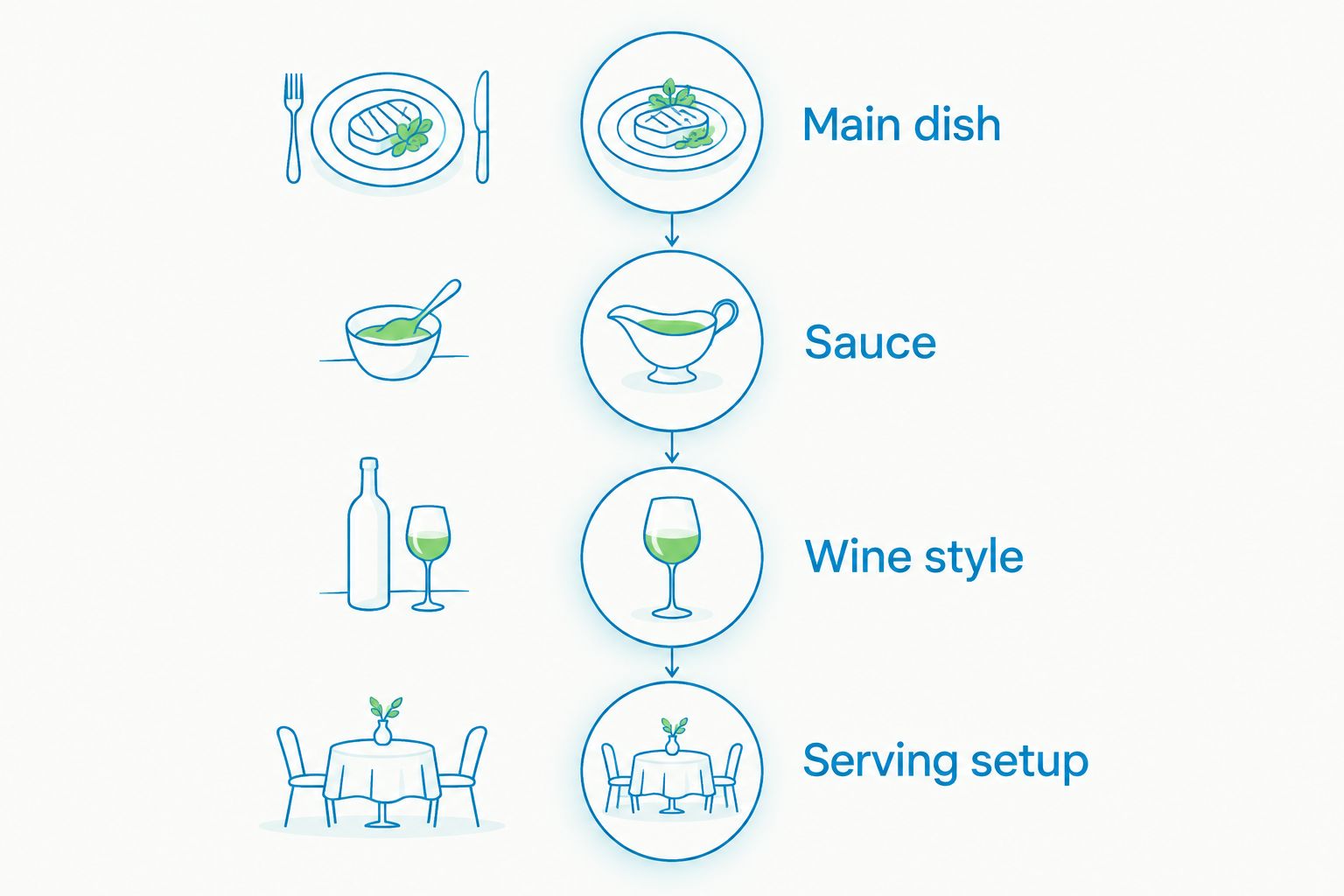
Use this short sequence when planning dinner:
- Main dish: Decide whether the meal is light, moderately rich, or concentrated.
- Sauce: Identify the dominant element: cream, savory stock, tomato, sweetness, or heat.
- Wine style: Choose restrained, fruit-forward, or fuller Merlot accordingly.
- Serving setup: Keep the bottle away from kitchen heat and make water part of the table.
For a special meal, resist adding more bottles just to make the occasion feel elaborate. Thoughtful anniversary dinner experiences depend on the menu and setting; your Merlot choice should support those decisions rather than become the evening's main task.
Keep dessert separate from the main-course pairing. A dry Merlot is not automatically a match for sweet chocolate cake just because its description mentions cocoa or dark fruit. Those words describe flavors, not a promise of sweetness.
Serve Merlot slightly cool, not kitchen-warm
A practical serving target for Merlot is 60–65°F. Treat that as a starting range, then adjust to the bottle and your preference. The goal is a cool red wine, not one warmed by an oven or chilled until its flavors feel muted.
For a standard 750mL bottle, a 150mL pour divides the bottle into five equal portions. That is a planning calculation, not a drinking target. Smaller pours leave room in the glass and let you decide whether you want more.
Set out clean wine glasses, drinking water, and a nonalcoholic option before dinner. You do not need a separate glass shape for each Merlot style. Use a glass with enough room to swirl without filling it to the rim.
Taste before deciding to decant. Young, firm reds can change with air, but a fixed decanting time does not suit every bottle. If the wine already tastes balanced, serve it rather than following an arbitrary countdown.
After dinner, reseal the bottle and refrigerate it. Bring your next pour back toward serving temperature rather than leaving the whole bottle on the counter; the guide to storing an open bottle of wine covers that next step.
Which Merlot should you choose in 2026?
Choose fruit-forward varietal Merlot if you are undecided. It is the strongest default for a cozy dinner with a mixed savory menu. Move to restrained Merlot for mushrooms, fuller Merlot for a braise, or M De Magnol when a Merlot–Cabernet Sauvignon blend is what you want.
Before placing a 2026 order, confirm the grape description, vintage, and bottle size. Miramar Wine & Liquor offers same-day local delivery and in-store pickup for San Diego-area consumers. Check the delivery arrangements for your address rather than assuming a specific arrival time.
FAQ
What's the best merlot wine for a cozy dinner in 2026?
A fruit-forward varietal Merlot with moderate tannins is the best default for a mixed savory dinner menu. Choose a restrained style for mushrooms and a fuller style for rich beef braises.
Is M De Magnol a pure Merlot?
M De Magnol Haut Medoc Barton And Guestier is a Merlot–Cabernet Sauvignon blend, not a standalone Merlot recommendation. Its product description does not specify the proportions of those grapes.
Is Merlot sweet or dry?
Merlot is commonly made as a dry red wine. Plum, blackberry, or chocolate flavor descriptions do not establish sweetness, so check the specific bottle description.
Is Merlot better than Cabernet Sauvignon for dinner?
Neither grape is better for every dinner. Choose according to the bottle's body, tannins, and oak influence, then match those characteristics to the food.
What food goes well with Merlot?
Merlot can pair with roast pork, meatloaf, mushroom dishes, and beef braises when its style matches the meal's weight. The sauce matters as much as the main ingredient.
Should I chill Merlot before serving it?
Serve Merlot slightly cool, with 60–65°F as a practical starting range. Keep it away from cooking heat and adjust the temperature to your preference.
Does Merlot need to be decanted?
Merlot does not always need decanting. Taste the bottle first and use air when a firm, closed wine benefits from it rather than applying one fixed time to every bottle.
Can I get wine delivered locally in San Diego?
Miramar Wine & Liquor offers same-day local delivery and in-store pickup for San Diego-area consumers. Confirm the arrangements for your address and order before planning dinner around an arrival time.
One last thing
Fruit flavor is not sweetness. A dry Merlot can taste of ripe plums, and a soft-feeling wine can still contain noticeable tannins. When choosing the best merlot wine, separate sweetness, fruit, and texture instead of treating them as one characteristic.
Write down your main dish and whether you prefer restrained or fuller reds before shopping. That simple request is more useful than asking for the most impressive Merlot label.